

Immerse yourself in the traditional dances of Peru. From the elegant Marinera to the wild Diablada. Discover the history and where to experience them.
I clearly remember an afternoon in the Plaza de Armas in Cusco. The heavy, newly lit doors of the Cathedral contrasted with the sky that was beginning to darken. Suddenly, the respectful silence was broken by the shrill sound of a bass drum and the wail of a bamboo flute. The cobblestone ground seemed to vibrate as dozens of dancers, wearing embroidered costumes in colors that challenged the rainbow, took over the square. It wasn’t just a show for tourists; it was the very history of those people being told with their feet.
When planning your journey and researching what to do in Peru in 2026, you will likely note down temples, ruins, and Michelin-starred restaurants. But the true cosmopolitan traveler knows that the soul of a country is not found only in static stones; it moves, breathes, and perspires in its celebrations.
In this guide, I won’t just present a list of traditional dances of Peru. I will take you behind the scenes of this profound cultural expression. You will discover why these dances are so vital and exactly where you can witness them in all their authentic glory.
Get ready. The rhythm of the Andes is about to capture your heart.
Why are traditional dances of Peru so important? | The Overview
When you look for a traditional dances of Peru summary, the deepest answer is: resistance and syncretism.
The traditional dances of Peru are not just artistic displays; they are the newspapers and history books of peoples who did not use traditional writing.
- Syncretism: When Spanish colonizers banned many native religions, the indigenous people hid the worship of their nature gods (such as Pachamama or the mountain gods, the Apus) within the choreographies created to honor Catholic saints. Every leap, every color, and every mask tells a story of adaptation and survival.
This rich cultural fabric is the heart of authentic Tourism in Peru. If you want to understand the country, pay attention to the dance steps.
DID YOU KNOW?
The Scissors Dance | Danza de las Tijeras: Recognized by UNESCO as Intangible Cultural Heritage, this Andean dance requires almost superhuman physical endurance. Dancers perform spectacular acrobatics while clashing metal blades similar to scissors, representing an ancient spiritual connection with celestial and terrestrial deities.
What are the main traditional dances of Peru by city? The Geography of Movement
Peru is fortunate to have three very distinct geographical regions: the coast, the Andes (highlands), and the Amazon rainforest (jungle). The traditional music and dance of Peru changes drastically according to altitude and climate.
To give you an authentic view, here are the dances that dominate the different regions:
1. The Elegance of the North and the Coast | Trujillo and Lima
- The Marinera Norteña: If passion were a dance, it would be the Marinera. It is the unofficial national dance of Peru. It is an elegant game of seduction between the man (wearing a sombrero and poncho) and the woman (barefoot and in flowing skirts), communicating solely through the movement of white handkerchiefs. It is the sophistication of the coast materialized.
2. The Rhythm of the Jungle
- The Boa (Anaconda) or Constrictor Dance: The Peruvian Amazon is hot and vibrant, and its dances reflect this. With costumes imitating reptile patterns and striking drums, this rustic dance pays homage to sacred snakes, asking for protection against floods.
3. The Majesty of Cusco and the Sacred Valley
- The Valicha: One of the most romantic and joyful traditional dances of Peru, originating in Cusco. Danced to the sound of huayno, couples dance gracefully in colorful sheep and alpaca wool clothing, celebrating youthful flirting in the mountains.
4. The Strength of the Altiplano | Puno
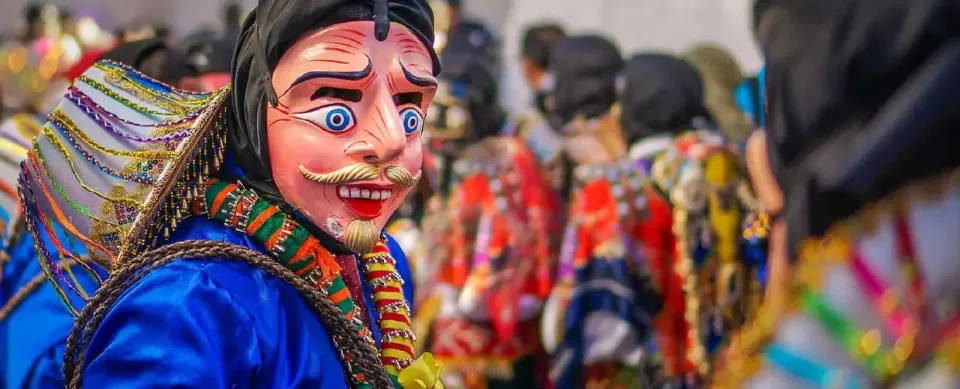
- The Diablada: Puno is the Folkloric Capital of Peru. The Diablada is the crown jewel. With grotesque demonic masks adorned with gold, silver, and dragons, the dancers represent the eternal struggle between good (Archangel Michael) and evil. It is a powerful, loud, and unforgettable spectacle.
5. The Heritage of Arequipa
- The Wititi: Originating from the Colca Valley, this “dance of love” is famous because men wear overlapping skirts (to disguise themselves and approach women during the courtship) and intricately decorated hats. It is also a Masterpiece of the Intangible Cultural Heritage of Humanity.
The Afro-Peruvian Soul: The Rhythm That Warms Peru’s Coast
When talking about traditional dances of Peru, it is a mistake to focus only on the Andes and the Amazon. The southern coast (especially the Ica and Chincha region) houses a rich Afro-Peruvian heritage. Enslaved people brought to Peru during the colonial era were not allowed to use their traditional instruments, so they improvised, creating one of the most fascinating musical branches in the Americas.
The Festejo and the Alcatraz
- The Festejo: It is the festive dance par excellence of the coast. It is pure vibration, joy, and sensuality. The agile pelvic movements and the unmistakable beat of the Peruvian Cajón (a wooden box-shaped percussion instrument that Peru exported to the whole world, including Spanish flamenco) make this dance a contagious spectacle.
- The Alcatraz: An incredibly playful and humorous courtship dance where the man tries to light a piece of fabric attached to the back of the woman’s waist with a candle, while she dodges with quick hip movements.
For travelers wishing to explore the roots of this coastal culture, combined with the sun and dunes, read our guide on what to do in Peru in 2026, where we detail tours of the Ica desert.
Huaylarsh: The Strength of the Fields | Huancayo
Heading back up to the central Andes, the Huaylarsh is the dance of the potato harvest and sowing season.
- The Movement: The footwork (sapateado) is intense, strong, and loud. Dancers imitate the strong treading on the earth (to sow) and the courtship of Andean birds. The physical vigor required to dance the Huaylarsh at over 3,000 meters above sea level would leave any Olympic athlete impressed.
At which festivities can I enjoy these dances? | The Cultural Calendar
You can pay to see a folklore show, but watching these traditional dances of Peru in the streets, celebrated by the communities themselves, is a transformative experience. Searching for traditional dance of Peru often leads you directly to the country’s major festivals.
1. The Inti Raymi | Cusco
- When: June 24th.
- The Event: The Festival of the Sun is Cusco’s most iconic celebration. The entire city stops, and dancers representing the four suyos (regions) of the Inca Empire converge at Sacsayhuamán. It is the essence of imperial choreography.
2. The Virgin of Candelaria | Puno
- When: February.
- The Event: The largest festival in Peru. For days on end, the streets of Puno become a river of traditional dances of Peru. This is where you will see the Diablada in its most glorious form, with tens of thousands of dancers enduring the altitude out of pure devotion.
3. Marinera Festival | Trujillo
- When: January.
- The Event: A national competition that attracts the best dancers in the country, all seeking the supreme prize of coastal elegance.
To plan your trip around these spectacular events, consult our calendar and in-depth guide on Festivals in Peru 2026.
The Art of Dressing Tradition | The Luxury and Weight of the Costumes
The traditional dances of Peru are not just a spectacle of movement, but an authentic parade of ancestral haute couture. The sophisticated traveler will immediately notice that the garments are not mere costumes; they are works of textile art, often passed down from generation to generation.
- The Weight of Devotion: Did you know that the mask and cape of a “Diablo Mayor” in the Diablada dance (in Puno) can weigh up to 30 kilograms (66 lbs)? Dancing with this weight at an altitude of 3,800 meters requires brutal physical preparation, which dancers endure fueled by pure faith in the Virgin of Candelaria.
- Gold and Silver Threads: In the “Suits of Lights” (Trajes de Luces) used in Puno and Cusco, it is common to find real embroidery in metallic threads, inlaid mirrors, and crystals. Crafting one of these suits by hand can take months and cost thousands of dollars. It is an investment made by an entire community.
CURIOUS FACT
The “Polleras” (the wide Andean skirts) aren’t just for twirling. The number of skirts an Andean woman wears during a dance and the quality of the wool (often fine Baby Alpaca) historically demonstrated the social status and wealth of her family.
The Soundtrack of the Andes: Native Instruments
There is no traditional dance of Peru without its corresponding beat. Andean music possesses an unmistakable sonic DNA that touches the traveler’s soul from the very first day.
- Zampoña and Quena: The wind instruments. The Zampoña (Andean panflute) provides a vast, melancholic tone, like the sound of the wind crossing snowy peaks. The Quena (a wood or bone flute) is sharper and faster, dictating the joyful rhythms.
- The Charango: A small stringed instrument, similar to a mandolin. Originally, its resonance box was made from the shell of an armadillo (quirquincho), though today they are made of carved wood. Its rapid, high-pitched sound is the heart of dances like the Valicha.
For International Travelers: Rhythm, Connection, and Peruvian Charm
For our friends from the UK, US, and Australia, we know you appreciate cultural depth and vibrant energy. While Western festivals often focus on modern music, Peru expresses its celebratory spirit through a different lens.
If you are looking for a trip that blends archaeological richness with a colorful nightlife, I strongly advise experiencing our festivities. In many countries, festivals are commercial; here in Peru, devotion to Catholic saints and sacred mountains results in parades that last for days, filled with brass bands and costumes that weigh dozens of pounds.
If you are looking for traditional dance of Peru for kids to entertain the family and teach culture in a playful way, the performances at the Centro Qosqo de Arte Nativo in Cusco are visual, interactive, and safe.
To pair the comfort you deserve with this cultural explosion, I invite you to explore our meticulous Peru Packages, specifically designed to balance intense exploration with well-earned luxury.
ADVICE GRAND
The Art of “Slow Travel”: When attending a festival in Peru, do not be in a hurry. Andean celebrations do not have a rigid end time. Sit at a café in the Plaza de Armas, order a Pisco Sour, and let the spectacle of the dancers pass you by at their own pace.
How many days should I travel to appreciate the culture and dance?
True culture cannot be rushed.
- The Recommendation: To properly experience Inca culture, watch a show of traditional dances of Peru (and perhaps join a local party in Cusco) while still seeing wonders like Machu Picchu, I recommend a minimum of 10 days.
- The Ideal Itinerary: With 10 days, you don’t just visit the highlights; you understand the region. Our 10-Day Historical and Gastronomic Peru package is perfectly structured to absorb the landscapes by day and the vibrant culture by night.
Where to watch the dances if I’m not there during a festival? | Dinner Shows
Many guests ask: “What if my dates don’t coincide with Inti Raymi or Candelaria? Can I still see these dances?” The answer is yes. Peru understands that its heritage should be shared year-round.
- In Lima: Renowned venues like Brisas del Titicaca or Dama Juana offer theatrical-level shows every night. You dine on the finest coastal gastronomy while the stage displays everything from the Marinera to the Festejo.
- In Cusco: The famous Tunupa restaurant (with one branch in the Plaza de Armas and another incredible one in the Sacred Valley) offers sumptuous buffets next to the stage. Savoring an Andean roast while watching the “Danza de las Tijeras” live in a warm, cozy hall is the pinnacle of cultural comfort.
ADVICE GRAND
The Complete Experience: If you want to unite high Peruvian gastronomy with artistic performances elegantly, request that we include “Folklore Dinner” nights in your itinerary when booking our award-winning Peru Packages. We will ensure you have tables with the best view of the stage.
Frequently Asked Questions | FAQ
1. What are the most famous traditional dances of Peru for tourists in Cusco?
In Cusco, Andean dances like the Valicha and the masked dances that accompany Carnival and Corpus Christi are the most prominent. Many are choreographies that reenact ancient agricultural activities.
2. Can I watch traditional dances of Peru throughout the year?
Yes. Although major festivals occur on specific dates (like Inti Raymi in June), cultural centers in Lima and Cusco (such as the Centro Qosqo de Arte Nativo) present dance shows almost every night.
3. Is it appropriate to take photos or videos of street dances?
Totally appropriate and welcome! Street festivities are public demonstrations of pride. A smile and a friendly nod are always the best ways to connect.
4. Is the Peruvian Marinera danced in the Cusco region?
Not traditionally. The Marinera is the pride of the northern coast (Trujillo) and Lima. In the Andes, the dominant rhythms are Huayno, San Juanito, and dances of agro-pastoral origin.
5. Is it hard to adapt to the altitude while enjoying festivals in Cusco and Puno?
The altitude in Cusco (3,400 m) and Puno (3,800 m) demands respect. We advise resting on the first day and staying well-hydrated. Interestingly, Andean dancers perform exhausting choreographies at these altitudes without losing their breath—a testament to the local population’s genetic adaptation!
IMPORTANT FACT
The “Danza de las Tijeras” (Scissors Dance) was recognized by UNESCO as Intangible Cultural Heritage of Humanity. The dancers are considered mediators between the gods and men.
The Stage of the Andes
My fellow traveler, the traditional dances of Peru are much more than movement. They are the elegant stubbornness of an ancient culture that refused to be silenced by history. When you observe the rhythmic stomping of feet in Puno or the delicate sway of a handkerchief in Trujillo, you are witnessing the authentic, pulsing, and immensely proud Peru.
At Peru Grand Travel, we believe that travel is the privilege of being moved. We don’t just offer transfers and hotels; we offer the front-row key to the great spectacle of South America.
Are you ready to let yourself be carried away by the rhythm of the Andes? Contact us today, and let’s start designing your cultural immersion in the Land of the Incas.
To review the planning guide that starts it all, return to our essential pillar article: What to do in Peru in 2026. The show awaits.