

If you are looking for the true soul of the Peruvian Andes, look no further than the Ayacucho Carnival. While other cities might offer larger parades or
Why Ayacucho is the “Capital of the Peruvian Carnival”
A National Cultural Heritage Site
In 2003, the Ayacucho Carnival was officially declared a National Cultural Heritage by the Peruvian government. This isn’t just a “party”; it is a complex social ritual where the community expresses its identity through music, dance, and satire. It is one of the few places where the ancient Andean worldview perfectly blends with Spanish colonial influences.
The Transformation of the “City of 33 Churches”
Ayacucho is world-famous for its 33 colonial churches and its solemn Holy Week (Semana Santa). However, during Carnival, the city undergoes a radical transformation. The quiet, stone-paved streets suddenly erupt with the sound of thousands of voices and string instruments. The solemnity is replaced by “Puqllay” (the Quechua word for play), turning the entire city into a giant, open-air theater.
Key Events You Can’t Miss During the Celebration
The Grand Entrance of “Ño Carnavalón”
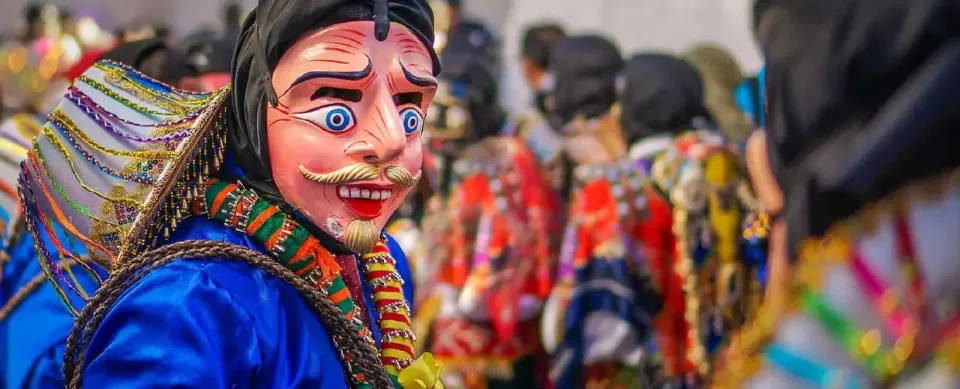
The festivities officially kick off with the arrival of Ño Carnavalón. This large-headed, colorful puppet represents the spirit of the carnival. He enters the city on a float, surrounded by music, signaling that for the next three days, joy is the only law. At the end of the festival, he is “read” a satirical will and testament before being symbolically buried.
The “Comparsas”: A Sea of Colors and Traditions
The heart of the festival is the Comparsas—organized troupes of dancers and musicians. Each neighborhood, university, and guild forms its own troupe. You will see women wearing beautiful embroidered polleras (skirts) and white hats with colored ribbons, while men play the tinya (a small drum) and the quena (Andean flute).
The “Coplas”: Satire, Humor, and Song
Unlike other carnivals that rely on recorded music, Ayacucho is all about the Coplas. These are rhyming verses sung in a mix of Spanish and Quechua. They are often mischievous, satirical, and highly political, mocking local leaders or telling stories of unrequited love. Listening to the crowd roar in laughter at a clever copla is a highlight of the trip.
Traditional Rituals and Ancient Customs
The “Yunza” or “Cortamonte” Ceremony
As you move away from the main square and into the local neighborhoods, you will encounter the Yunza. A large tree is planted in the ground, decorated with blankets, toys, and household gifts. Couples dance around it, taking turns hitting the trunk with an axe. When the tree finally falls, everyone rushes in to claim a prize. Tradition says that the couple who deals the final blow must organize and pay for the Yunza the following year!
The “Kacharpari”: The Bittersweet Farewell
The “Kacharpari” (the farewell) takes place on the final day. It is a massive, emotional exodus where the troupes dance their way out of the city center. It’s a moment of mixed emotions—exhaustion and joy, ending with the symbolic burial of Ño Carnavalón, marking the beginning of the Lenten season.
Gastronomy: The Flavors of the Ayacucho Carnival
The “Puchero Ayacuchano”: A Feast of Abundance
You cannot experience Carnival without eating Puchero. This hearty stew is a symbol of the harvest. It is made with dried meat (charqui), beef, pork, sweet potatoes, cabbage, chickpeas, and—uniquely—fruit like peaches and pears. It is a sweet and savory explosion that provides the energy needed to dance for hours.
Chicha de Jora and Local Spirits
The “fuel” for the carnival is Chicha de Jora, a fermented corn beer that has been sacred since the time of the Incas. In the heat of the celebration, you will also be offered “Siete Semillas” (a drink made from seven grains) or local cane spirits. Remember: it is considered polite to take at least a small sip when offered!
Essential Travel Tips for First-Timers
Booking Your Trip in Advance
For the 2026 Carnival, you should book your flights and hotels at least 4 to 6 months in advance. Ayacucho is a medium-sized city, and its infrastructure reaches 100% capacity during these dates. If hotels are full, many locals offer “homestays,” which can be a great way to experience the culture.
What to Pack: From Ponchos to Water Shields
- Clothes: Wear things you don’t mind getting “ruined.” You will be hit with flour, scented talcum powder, and serpentines.
- Protection: A waterproof windbreaker or poncho is essential, as February is the rainy season in the Andes.
- Gear: If you are bringing a professional camera, use a waterproof housing or a simple plastic bag to protect it from the “foam wars.”
Safety and Altitude (Soroche) Precautions
Ayacucho sits at 2,761 meters (9,058 feet). While it’s not as high as Cusco, you may still feel the altitude. Drink plenty of coca tea, stay hydrated, and avoid heavy meals on your first day. Regarding safety, keep your phone and wallet in a zipped inner pocket, as the crowds can be very dense.
FAQs Carnival Ayacucho
What is the Carnival in Ayacucho?
It’s one of Peru’s most traditional carnival celebrations, where neighborhoods and groups celebrate with live music, “comparsas” (dance troupes), “coplas” (satirical songs), and rituals like the Yunza (decorated tree ceremony), blending Andean and colonial traditions.
Where is the largest Carnival in the Hispanic world celebrated?
This depends on what you mean by “largest” (crowd size, duration, or fame). Some of the best-known massive carnivals in the Hispanic world include the Carnival of Santa Cruz de Tenerife (Spain) and the Carnival of Oruro (Bolivia). Ayacucho stands out not for being the biggest, but for being one of the most authentic and culturally rooted.
What happens at Carnaval?
You’ll see parades, dance and music groups performing in the streets, playful “wars” with foam/flour/streamers, community gatherings, food and drinks like puchero and chicha de jora, and key moments like the arrival and farewell of Ño Carnavalón.
Why is Carnival so famous?
Because it’s a living tradition—full of symbolism, humor, music, and community identity—where people preserve ancestral customs while celebrating openly in the streets. In Ayacucho, Carnival feels less like a show and more like the whole city taking part in a shared cultural ritual.
Ready to discover them? Traveling is about discovering, learning, and creating unforgettable memories, and Peru is the perfect destination for all of that. Its landscapes, history, and culture make every experience unique, filled with moments that will change your life.
We invite you to explore our Peru packages. Your experience in Peru is just one step away. Contact us now and start living the unique adventure you’ve always dreamed of.
More information:
- Visit our English website: Peru Grand Travel
- Visit our Spanish website: Viajes Machu Picchu Tours
- Visit our Portuguese website: Machu Picchu Pacotes