

Planning your Inca Trail hike? Discover the detailed The Inca Trail 4 days itinerary, daily elevation gains, and crucial backpacking tips. Your essential guide to this challenging trek to Machu Picchu.
Welcome. If you’re reading this, you’ve likely decided to embark on the world’s most iconic trekking experience: the Inca Trail 4 days to Machu Picchu. A magnificent choice, one that offers not just historical immersion but a profound personal challenge, awaits you.
As your host, I understand that planning this specific hike requires meticulous detail, far beyond a simple booking. You need to know the daily rhythm, the exact challenges, and how to manage the high mountain elevation.
Let’s walk through the exact itinerary, logistics, and expectations for the Inca Trail 4 days – classic experience.
What is the Day-by-Day Itinerary for the Inca Trail 4 days – Classic?
The Inca Trail 4 days covers roughly 45 kilometers (28 miles) over four days. It is a carefully managed sequence of ascents, descents, and historical stops, designed to maximize both the physical challenge and the cultural reward.
Day 1: Acclimatization and Ancient History | The Inca Trail 4 days
Day one is intentionally designed to ease you into the trekking rhythm and the high altitude.
- Route: Ollantaytambo area to Wayllabamba campsite.
- Distance: Approximately 14 km (8.7 miles).
- Challenge: Moderate. The trail is relatively flat in the morning, gradually ascending.
- Key Sites: You will pass the spectacular Inca ruins of Patallacta (Llactapata), offering a fantastic photo opportunity.
- Elevation: You start around 2,750m (9,020 ft) and end the day at the Wayllabamba campsite, approximately 3,000m (9,840 ft). The key here is maintaining a slow, steady pace.
Day 2: The Altitude Challenge | Dead Woman’s Pass | The Inca Trail 4 days
This is the day that defines the Inca Trail 4 days (classic). It is the longest, most challenging ascent and descent of the entire hike.
- Route: Wayllabamba to Pacaymayo campsite.
- Distance: Approximately 12 km (7.5 miles).
- Challenge: Strenuous. You face a sustained ascent followed by a steep descent.
- Summit: Warmiwañusca (Dead Woman’s Pass), the highest point of the Inca Trail at 4,215 meters (13,828 feet) of elevation.
- Strategy: Hydrate continuously and trust your guide to set a sustainable pace. The descent is hard on the knees, requiring trekking poles.
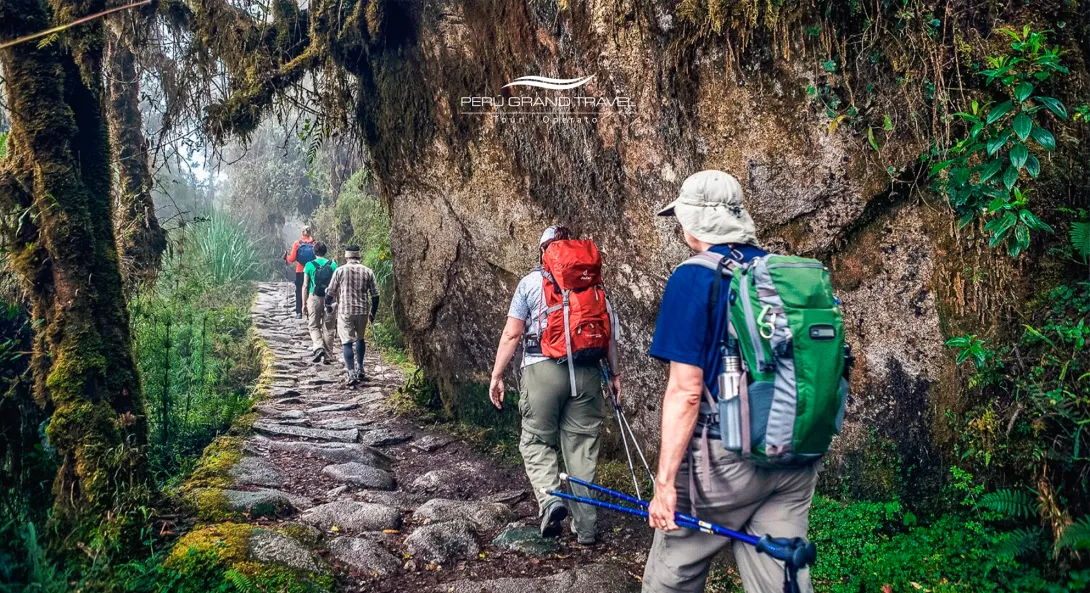
Curious Fact about the Inca Trail: The steps and pathways you hike today were built over 500 years ago without the use of mortar. The stones were cut and fitted so precisely that the Incas did not need wheels or metal tools, reflecting engineering brilliance at a challenging elevation.
Day 3: Architectural Wonders and Cloud Forest | The Inca Trail 4 days
After conquering the high pass, Day 3 offers a rewarding sequence of preserved Inca architecture and beautiful sub-tropical cloud forest views.
- Route: Pacaymayo to Wiñay Wayna campsite.
- Distance: Approximately 16 km (10 miles).
- Challenge: Moderate to Strenuous. Includes two smaller passes (Runkurakay and Phuyupatamarca) and many downhill Inca steps.
- Key Sites: Runkurakay (a circular watchtower), Sayacmarca, and the magnificent Phuyupatamarca (‘Town in the Clouds’). The day ends near the exquisite Wiñay Wayna ruins.
- Logistics: The final campsite, Wiñay Wayna, is usually the closest to Machu Picchu and is often celebrated as the best night on the trekking route.
Day 4: The Arrival and The Lost City | The Inca Trail 4 days
The final day is short but emotionally charged, culminating in your arrival at the Lost City.
- Route: Wiñay Wayna to Machu Picchu (Sun Gate).
- Distance: Approximately 5 km (3 miles).
- Challenge: Easy to Moderate. Mostly flat or downhill stone path.
- Highlight: Reaching the Sun Gate just as the sun rises over Machu Picchu (weather permitting).
- Finish: After descending from the Sun Gate, your guide will take you on a detailed tour of the citadel.
Why is the Inca Trail 4 days to Machu Picchu the Ultimate Trekking Choice?
Many travelers ask why the Inca Trail 4 days remains the most sought-after route when there are alternatives like Salkantay or Lares. The answer is simple: access and history.
The Inca Trail 4 days or Classic, is the only trekking route that allows you to walk directly through the Sun Gate (Intipunku) and descend into Machu Picchu on foot. It follows the path reserved for Inca royalty, connecting sacred elevation points and major ceremonial centers. No other hike offers this level of historical continuity.
If you are just beginning your research and need a comprehensive overview covering permits, backpacking strategies, and health tips for high elevation, I recommend consulting our ultimate resource. For a detailed breakdown of all the moving parts, from booking windows to packing lists, this guide serves as the essential starting point for any successful Inca Trail adventure:
For a complete, high-level overview of the entire experience, including critical information on permits, altitude, and preparation, please read our Ultimate Inca Trail to Machu Picchu Guide 2026.
How Much Elevation Gain Should I Expect Daily on the Inca Trail 4 days?
Understanding the elevation profile is essential for physical and mental preparation. It’s not just the altitude that matters, but the rapid gain and loss. This is the difference between a successful hike and struggling with altitude sickness.
The sharpest increase is on Day 2, where you gain over 1,200 meters from the start of the day to the pass. This is why spending two to three days acclimatizing in Cusco (3,400m) before heading to the trailhead is non-negotiable.
What Should Be in My Backpacking Daypack for the Inca Trail Hike?
When embarking on the Inca Trail 4 days (classic), you divide your gear: the main duffel (carried by porters) and your personal daypack (carried by you). Your backpacking daypack is your lifeline for 6–8 hours of trekking.
This pack should be comfortable, ideally 20–30 liters, and contain the following essentials:
- Hydration: At least 2-3 liters of water capacity (bladder or bottles).
- Clothing: Rain gear (jacket and pants, regardless of the season) and a thermal fleece or down jacket for breaks at high elevation.
- Sun Protection: Sunscreen, a wide-brimmed hat, and sunglasses (UV radiation is severe at this altitude).
- Essentials: Passport (required at the KM 82 checkpoint), a headlamp, personal medication (including pain relievers), and blister treatment.
- Fuel: High-energy snacks (nuts, chocolate, energy bars) to supplement the meals provided by the crew.
Still not sure exactly what you should pack for your classic Inca Trail trek? Find out here how to prepare your backpack.
Advice: Do not overpack your daypack. Every kilogram will feel like two when ascending to 4,215 meters of elevation. Only carry what you need between campsites.
Are There Any Inca Trail Tours That Start Directly from Cusco?
This is a common question, and the answer requires a logistical clarification: While the majority of Inca Trail tours are booked and managed by agencies based in Cusco, the actual trekking does not begin in Cusco city.
The Logistics of Starting the Inca Trail
- Preparation (Cusco): You will spend 2-3 days in Cusco for mandatory acclimatization and the initial pre-trek briefing with your guide.
- Departure (Early Morning): Your tour agency will pick you up from your hotel in Cusco (usually between 4:00 AM and 5:00 AM).
- Transport: You travel for approximately 3–4 hours by bus or van from Cusco, through the Sacred Valley, to the trailhead at Kilometer 82 (Piscacucho). This is where the hike officially begins.
Therefore, when you book Inca Trail tours advertised as starting from Cusco, it means your journey begins with pickup in the city, but the actual trekking starts at a much lower elevation point on the rail line near Ollantaytambo.
When is the Best Time to do the Inca Trail 4 days?
Timing matters more than people expect.
Best Months To Visit The Inca Trail 4 days
- May to September: Dry season, cooler nights, high demand
- April & October: Fewer crowds, pleasant weather
Months Not Recommended to Visit The Inca Trail 4 days
- February: Trail closed for maintenance
Booking early is essential, especially during peak season.
For a complete breakdown of seasons, permits, and planning tips, I highly recommend reading our complete Inca Trail to Machu Picchu guide. It connects all the details you need in one place and helps you avoid common mistakes: Inca Trail to Machupicchu 2026
Think of it as the compass that brings clarity to your planning.
Frequently Asked Questions (FAQ)
These are the immediate logistical questions every serious traveler has before committing to this trekking experience.
Are there any hotels or accommodations along the Classic Inca Trail?
No. The Classic Inca Trail is strictly a backpacking trip. All three nights are spent camping in designated campsites managed by the Peruvian government. Your Inca Trail tour package includes the tents, sleeping mats, and dining facilities carried by your porter team.
Can I hike the Inca Trail without acclimatizing to the elevation first?
Attempting the Inca Trail without spending 2-3 days prior in a high-altitude city like Cusco (3,400m) is dangerous and highly discouraged. Acclimatization is essential to prevent severe altitude sickness, especially before tackling the 4,215m elevation of Dead Woman’s Pass.
Is it true that the Inca Trail is closed in February?
Yes, the entire Inca Trail is closed every February for mandatory maintenance, conservation work, and cleaning. This period coincides with the peak of the rainy season, minimizing traveler impact. If you plan your trips to Machu Picchu in February, you must choose an alternative route (like Salkantay or Lares).
How do I manage my garbage during the 4-day trekking trip?
Ethical backpacking requires a “Leave No Trace” approach. Your Inca Trail tour team will carry out all solid waste, including compostable material and any trash you generate. Guides provide bins at the campsite, but you must carry small personal items (like wrappers) in your daypack until you reach the next stop.
Are trekking poles required for the Inca Trail?
While not mandatory, trekking poles are highly recommended, especially for the steep descent from Dead Woman’s Pass. They significantly reduce the impact on your knees. Note that poles must have rubber tips to protect the original Inca stonework.
What is the maximum number of people allowed on the Inca Trail per day?
Only 500 people are allowed on the trail daily, and this number includes all support staff (guides, cooks, porters). The actual number of tourists permitted to hike is closer to 200 per day, making permit booking extremely competitive.
The Next Step in Your Inca Trail Planning
The 4-Day Classic Inca Trail is more than just a hike; it is an experience that will challenge you physically and reward you profoundly. By understanding this detailed itinerary and the elevation profile, you are already prepared beyond the average traveler.
The key to a successful journey lies in the logistics—securing your permits early, choosing the right tour operator, and optimizing your gear.
Ready to take the next step and secure your spot for a 2026 departure? Contact us at Peru Grand Travel. As your Anfitrión Cosmopolita, we specialize in managing the complex logistics of these high-demand trips to Machu Picchu, ensuring your backpacking adventure is executed flawlessly, from your arrival in Cusco to your triumphant walk through the Sun Gate.
We invite you to explore our Inca Trail packages! Your experience in Peru is just one step away! Contact us now and start living the unique experience you’ve always dreamed of.
More information:
- Visit our English website: Peru Grand Travel
- Visit our Spanish website: Viajes Machu Picchu Tours
- Visit our Portuguese website: Machu Picchu Pacotes